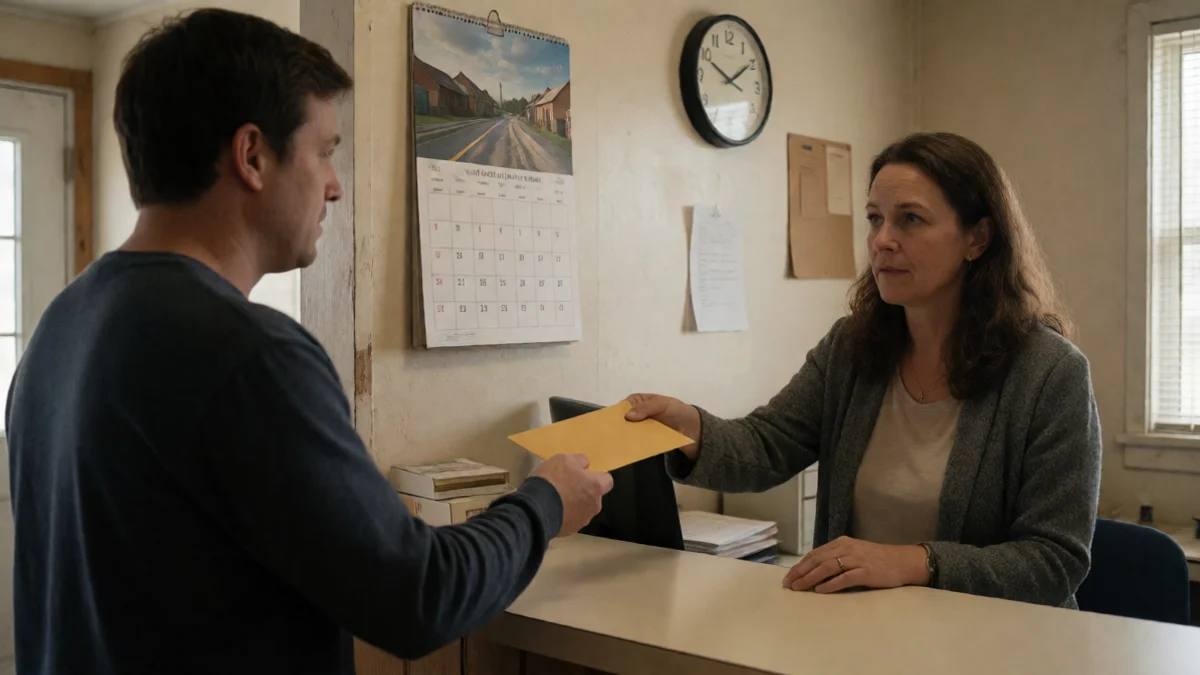
The process starts before any money arrives
The application commonly asks for identity, contact, income and bank information. That inquiry is not the loan itself: the binding event is acceptance of a contract that states the advance, charges, due date and repayment arrangement.
For an online transaction, identify the legal lender entity and its current Kansas status before sending sensitive information. The name on a website, text message or ad is not always the full legal name that appears on the loan documents.
Disclosures turn the offer into reviewable terms
Before signing, the offer should show the amount provided, each charge, the repayment amount, due date, payment method, default language and any authorization for a check or electronic withdrawal. Keep the exact version presented, including cancellation wording and the authorization record.
Kansas law limits a payday cash advance to $500, limits the finance charge to 15% of the amount advanced, and sets a term of at least 7 days and no more than 30 days. On a $300 advance, the maximum 15% finance charge is $45, making the scheduled repayment $345. The advance remains $300; the $45 charge does not expand the statutory advance cap.
For covered closed-end consumer credit, federal Truth in Lending disclosures include the finance charge, annual percentage rate, amount financed, total of payments and payment schedule. The APR is a standardized disclosure figure, while the finance charge is the dollar amount paid for the credit. Kansas also permits a borrower to rescind a payday loan without cost by returning the proceeds by the end of the next business day.
Acceptance and funding are separate events
Accepting a contract starts the funding sequence; it does not by itself show that funds are available. The agreement or confirmation identifies the delivery method, whether cash, check, card or account funding, and the relevant timing.
Illustrative timeline: a borrower accepts an electronic agreement, receives a lender confirmation, sees that the stated method is an account deposit, and then checks the account when the deposit is said to be available. The amount that arrives should match the amount advanced in the agreement, rather than a number inferred from the repayment total.
Payment authorization controls the scheduled collection path
The repayment clause sets the collection path: scheduled date, amount, bank account or check involved, and the authorization used to collect. A payday lender may use a post-dated check or authorization for an electronic withdrawal, so those details belong alongside the loan amount and due date in the borrower’s records.
The practical consequence is immediate: the account needs funds for the stated collection date if the agreement calls for an electronic debit, while a check-based arrangement depends on the instrument identified in the contract. The Consumer Financial Protection Bureau directs borrowers to their loan documents for the repayment method, amount and timing, and provides current guidance on electronic-payment issues.
Repayment can follow more than one path
The clean path is a payment collected on the stated date for the stated amount, followed by a lender receipt and a matching bank entry. The records matter more when the collection path departs from the contract.
A debit posts for the agreement’s stated amount on its stated due date.
The contract, lender account and bank statement point to the same transaction.
Keep the payment confirmation and the bank entry as the completion record.
The scheduled debit reaches an account without enough funds.
The expected collection has not completed as scheduled.
Check the contract’s payment and default terms, the bank record and any lender notice to establish what was attempted and what happened next.
A debit appears for a different amount or on a different date than the agreement states.
The bank entry no longer matches the scheduled collection record.
Compare the authorization and contract with the bank transaction, then contact the lender with the dates and amounts in hand.
A borrower does not recognize a payment entry connected to the lender.
There is no clear link between the account transaction and the borrower’s loan records.
Preserve the bank record and loan documents, raise the issue with the lender and use the Consumer Financial Protection Bureau complaint process if it remains unresolved.
Close the timeline with records, not assumptions
- Compare the signed contract, lender account history, payment receipt and bank statement after the due date.
- Record the date, amount and method of each payment attempt, along with communications about a discrepancy.
- Save contract files, confirmations and account screenshots outside the lender’s online portal.
- Kansas limits a lender and related interests to two outstanding payday loans to one borrower at a time and no more than three payday loans to that borrower within 30 days.
- A lender cannot use a new payday loan from that lender or a related interest to pay an existing payday loan from the same lender or related interest.
- For a Kansas payday loan made on or after January 1, 2025, an eligible borrower can request an extended payment plan by the close of the last business day before the due date. The option is available once in a 12-month period and requires at least four substantially equal installments. No extra fee applies while the borrower complies with the plan, and the borrower cannot take another payday loan during the plan.
- For unresolved questions about a lender’s Kansas status or a payment dispute, use current information from the Kansas Office of the State Bank Commissioner and the Consumer Financial Protection Bureau.
Where the factual details come from
- Why did my payday lender charge me a late fee or a non-sufficient funds fee? — Consumer Financial Protection Bureau
- What should I consider if I'm thinking about getting a payday loan online? — Consumer Financial Protection Bureau
- What are the costs and fees for a payday loan? — Consumer Financial Protection Bureau