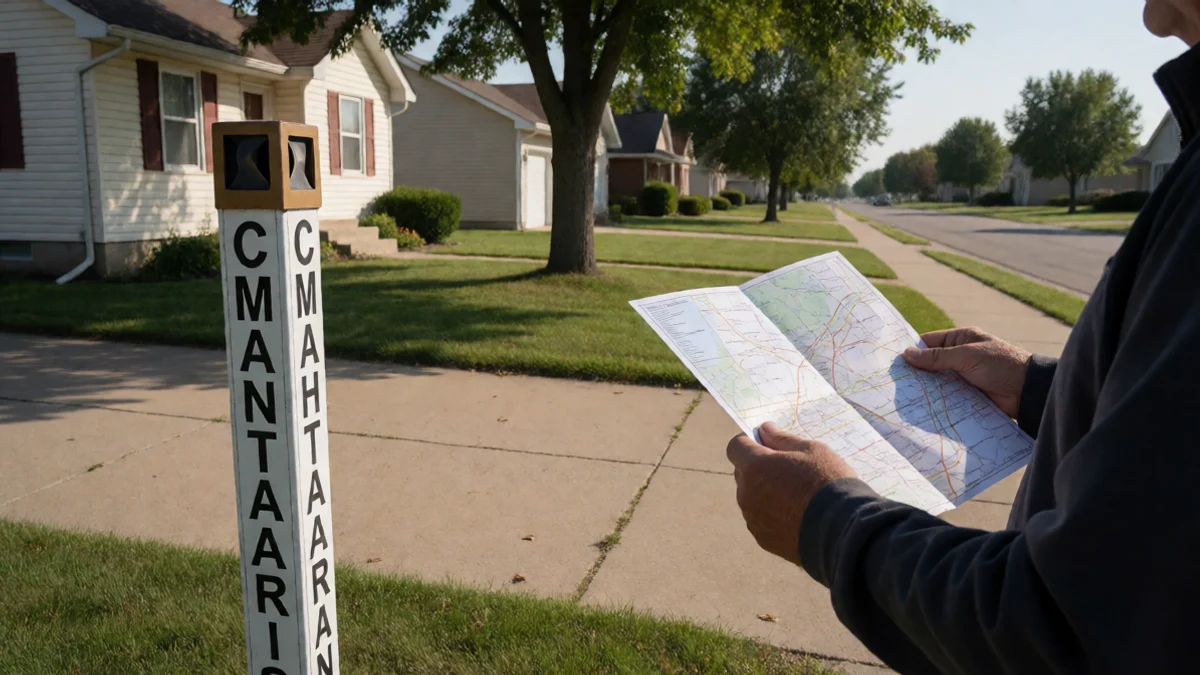
One Manhattan mailing city, two possible counties
Manhattan addresses can be associated with either Riley County or Pottawatomie County. That matters when a county program, nonprofit provider, or local fund defines its service area by the applicant’s physical residence rather than the city printed on mail.
Settle the county from an authoritative address source before building a list of local options. Then gather the address records that show the same residence. A mailing-city label is useful for delivery; it is a poor substitute for the county that a provider uses to decide its service boundary.
Sources that can verify the physical county
- An official county parcel or property-address tool is the strongest starting point for a house, apartment complex, or other fixed residence.
- An official county address, tax, or election lookup can confirm which county records the address when a parcel result is unavailable.
- A county office’s own address information can resolve a boundary question tied to a specific street address.
- A provider’s eligibility staff can identify the address format and county proof it requires after the county is established.
- Business directories, map snippets, and search-result labels are weaker evidence because they often describe the mailing city or a nearby business area rather than the county governing the residence.
Mailing address, service address, and current residence
A resource may ask for several different address facts. The mailing address is where correspondence goes. The physical or service address is the place receiving utility service or where the person actually lives. A billing address belongs to the account record. Those facts often match, but a campus residence, temporary stay, or recent move can split them apart.
The useful question is specific: which address does this provider use for its service-area rule, and which document proves it? A county-based route may need the current physical residence; a direct arrangement with a creditor or utility provider may center on the account’s service address. Where one route stops at a county boundary, move to a citywide or statewide channel whose stated eligibility covers the address, then keep the physical-address record ready for the next inquiry.
County-limited and county-neutral routes
| Route | County Role | Next Move |
|---|---|---|
| County-administered assistance | The physical residence determines whether the Riley County or Pottawatomie County route applies. | Identify the county first, then ask about the program’s address and document rules. |
| Private providers with defined service areas | A provider located in Manhattan may limit help by county or by the applicant’s physical address. | Match the stated service area to the verified residence before relying on the option. |
| Citywide contacts | Eligibility depends on the individual organization’s stated area rather than the mailing city alone. | Ask whether the current physical address falls inside its service boundary. |
| Statewide channels | These routes are not necessarily limited by the Riley–Pottawatomie boundary. | Use them when a county-specific inquiry does not cover the residence or cannot respond in time. |
| Direct hardship arrangement | The creditor, landlord, utility, or other biller generally focuses on the account and approaching due date. | Ask about a hardship arrangement while local-resource inquiries are pending. |
| Credit or payday-loan fallback | County verification does not establish loan eligibility, but it clarifies whether local expense assistance remains available first. | Compare timing, amount needed, fee, and repayment coverage only after the other routes have a known response window. |
Documents that can prevent an address delay
Requirements differ by provider, so ask the provider which of these records it accepts and whether the document must show the current physical address. The point is consistency: a different mailing address, old billing record, and new residence can turn a simple county question into an intake delay.
- A current lease, rental agreement, or housing statement showing the residence address.
- A recent utility, internet, or other service bill tied to the physical address.
- An account statement or official government correspondence bearing the current address.
- A current identification record when the provider accepts it as address evidence.
- Move-related records that explain a recent address change, such as a new lease or service-start notice.
- Campus housing records when the residence is university housing or another student arrangement.
When the deadline arrives before the county route responds
- Record the date of each county-specific inquiry, the contact reached, the documents requested, and the expected response or payment timing.
- Contact the creditor, utility provider, landlord, or other biller directly and ask for a hardship arrangement tied to the approaching expense.
- Use citywide or statewide channels whose stated eligibility is not confined to the county boundary when the local route cannot cover the verified address.
- Set a fallback checkpoint before the bill becomes irreversible: if the county route has not produced a usable answer by that point, move to the direct arrangement or broader route already identified.
- If a payday loan remains under consideration, assess the fee and repayment amount against the deadline it is meant to cover. In Kansas, a payday cash advance cannot exceed $500, the finance charge cannot exceed 15% of the amount advanced, and the term runs from 7 to 30 days. A $300 advance, for example, can carry a finance charge of up to $45, producing repayment of $345.
K.S.A. 16a-2-404 — Payday loans; finance charges; rights and restrictions
Sources for this guide
- K.S.A. 16a-2-404 — Payday loans; finance charges; rights and restrictions — Kansas Office of Revisor of Statutes
- Manhattan, Kansas — official information — Manhattan, Kansas
- Kansas Office of the State Bank Commissioner — Kansas Office of the State Bank Commissioner