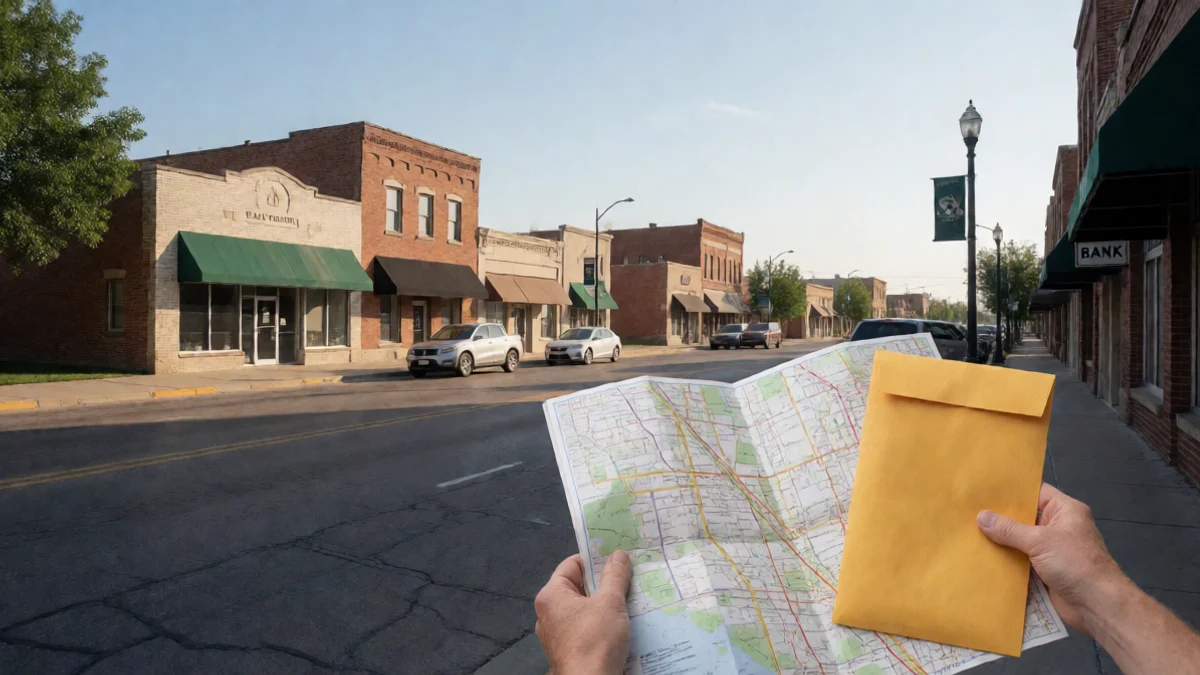
A Hays search result can represent several different access models
A search for payday loans in Hays can surface five very different channels. One is a confirmed loan office in Hays that actually offers the requested service. Another is a nearby office outside Hays, where distance returns as a real issue if signing, document delivery, or repayment requires another visit. A third is a remote lender that accepts Kansas applicants and delivers funds through a stated account channel. A fourth is an existing bank or credit-union relationship with an applicable small-dollar product. The fifth is a directory, advertising page, or lead form that gathers information without providing credit itself.
The distinction matters because a Hays address and an Ellis County address do not always produce the same result in a provider’s system. A listing is only a lead until it identifies the provider, the service offered, and the route through which an Ellis County resident receives and repays funds. Treat the access model as the first fact to establish, rather than treating the map pin or search label as an answer.
Test whether the channel works from application through repayment
- Identify the provider and establish whether it is a Hays office, a nearby in-person office, a remote Kansas-serving lender, an existing financial institution, or a lead form.
- Match the application’s accepted residence address to the address actually used by the applicant.
- Establish whether the route requires an in-person appearance, an appointment, a document upload, mailed paperwork, or a return visit. A nearby office only works as a practical channel when those obligations fit the route.
- Confirm the funding destination: the bank account, debit card, pickup method, or other delivery channel that receives the proceeds. An approval message is not the same event as money reaching that destination.
- Establish the repayment mechanism before providing sensitive information. The Consumer Financial Protection Bureau notes that payday lenders may use a post-dated check or authorization to withdraw from a borrower’s bank account, so the account and payment path are part of access, not an afterthought.
- Stop treating the option as available when its delivery method cannot meet the expense deadline or its repayment route cannot be used as required.
Consumer Financial Protection Bureau — What is a payday loan?
Address and affiliation can change which route is available
The address question gets sharper for students, temporary residents, and commuters. Someone living in Hays while using a permanent address elsewhere has two facts in play; someone working in Hays while living outside Ellis County has another. A lender, bank, credit union, or assistance program may use a residence address, institutional affiliation, employment connection, or another eligibility rule to decide which route is open.
Fort Hays State University affiliation, for example, is worth separating from an ordinary Hays mailing address when exploring student-facing emergency support. Likewise, an existing bank or credit union relationship deserves its own inquiry instead of being folded into a general lender search. Identify the address or affiliation the organization uses and get a direct answer on eligibility before counting that route toward an urgent expense.
Usable money has a different clock from an approval message
Suppose an Ellis County resident submits a remote application on Friday for an expense due Monday morning. The provider reviews the application, sends an approval notice, and initiates a transfer on Friday.
The earliest usable-funds time is the moment the posted money reaches the bill’s payment channel, not the moment the screen says approved. When that moment lands after the deadline, noncredit assistance through 211 Kansas, a campus resource for an eligible Fort Hays State University student, or another direct aid route addresses the timing problem more honestly than an approval notice does.
Record the evidence before treating the option as available
- Provider identity and the date the provider information was checked.
- Whether the result is a Hays loan office, an office outside Hays, a remote Kansas-serving channel, an existing bank or credit-union option, or a directory or lead form.
- Kansas availability and the address the provider accepts for the application.
- Any required in-person appearance, appointment, document-delivery method, or return visit.
- The funding destination and the earliest point at which the funds become usable for the specific expense.
- The repayment route, including whether it uses a bank account, post-dated check, debit authorization, online servicing, or an in-person action.
- Any fact still requiring direct confirmation, including the provider’s service location and whether it offers credit rather than another financial service.
- For a lender-status or conduct concern, the Kansas Office of the State Bank Commissioner and the Kansas Attorney General’s Consumer Protection Division are relevant state contacts. The CFPB also accepts complaints about consumer financial products and services, including payday loans.
Sources for this guide
- Consumer Financial Protection Bureau — What is a payday loan? — Consumer Financial Protection Bureau
- Consumer Financial Protection Bureau — Submit a complaint — Consumer Financial Protection Bureau
- What should I consider if I'm thinking about getting a payday loan online? — Consumer Financial Protection Bureau